|
Home
| CV and publications | Features | |
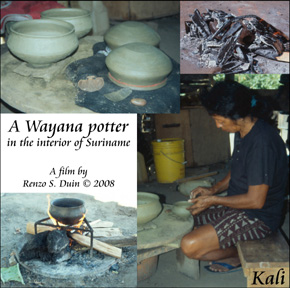
Trained as an anthropologist (at the University of Florida) and as an archaeologist (at the University of Leiden), I study the deep-time cultural history of the frontier zone of Suriname, French Guiana and Brazil with the contemporary Wayana indigenous people. Questions raised during my fieldwork in Caribbean archaeology were the basis for my current studies on architecture, settlement patterning, and socio-political organization in the Guianas and Amazonia. Living among the Wayana and learning about their present-day life and oral tradition provided insight into site formation processes and postdepositional processes that affect the archaeological record, and the Wayana cultural heritage. Moreover, living among the Wayana provided insight into emerging dynamic inter-regional communities in the socio-political landscape of seemingly egalitarian societies. Indigenous oral history and social memory appears to provide a different picture of the indigenous past and present in Amazonia than assumed from historical sources and ethnographic fieldwork conducted in the 1950s, and '60s. This website provides links to my background and current work. Click on the respective links for my CV and a list of PUBLICATIONS. Feel free to contact me by email with regard to consultation, research, and/or your graduate committee.
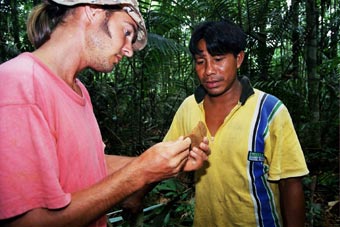
Dialogue about newly found potsherds between Aimawale (Wayana) and Renzo (Dutch) . Southeast Suriname. 2003.
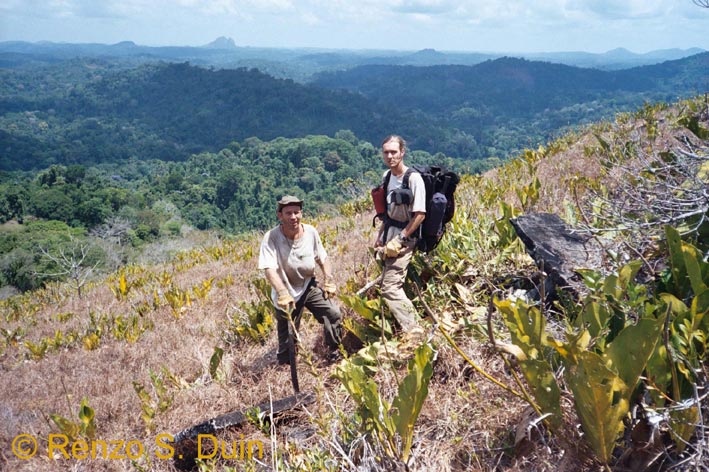
Prospecting the inselbergs in the contested area between Suriname and French Guyana, near the border with Brazil. October 30, 2004 |
As a Ph.D. candidate at the University of Florida, Gainesville (Chair: Michael Heckenberger [Science Article], and Co-Chair: Robin Wright), I conducted ethno-archeological research among the Wayana in Suriname, French Guiana and Brazil. Initially, my goal was to understand formation and post-depositional processes that bias the archaeological record. Subsequently the Wayana asked me: "Why don't you want to study OUR past?" and they began telling me narratives of times long ago; oral histories and mythologies. The Wayana even went upstream with me to trace back their origins and read the tracks of their ancestors. Digging into the past, based on (oral) histories results in creating alternative historicities (dissertation Duin 2009). see also
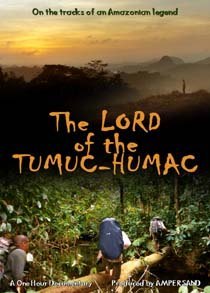
Association Alabama provided the means to initiate archaeological prospections is the most remote areas of the contested area between Suriname and French Guyana on the border of Brazil. Wayana oral tradition, history, archaeology and adventure are all supporting this research. In a 2005 publication a combination of Wayana oral tradition, scientific research and great pictures ware presented to illustrate our 2004 expedition on the traces of Kailawa (DVD). |
| 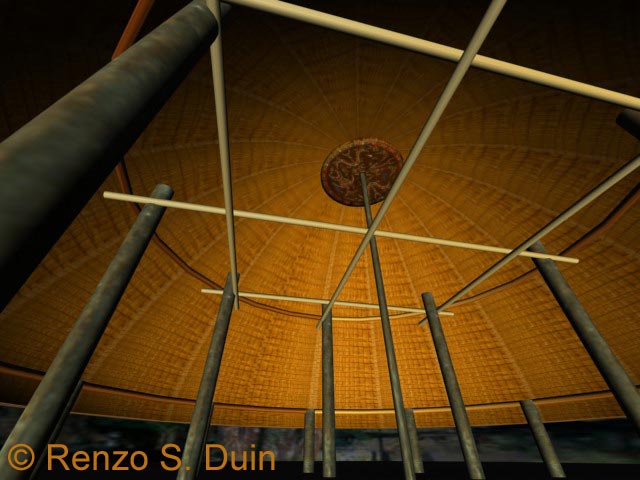
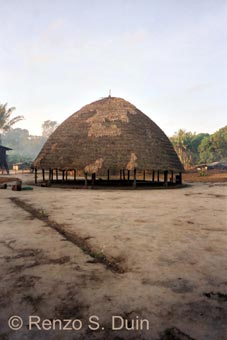
3D illustration (by Renzo S. DUIN) of the interior of a Tukusipan. | 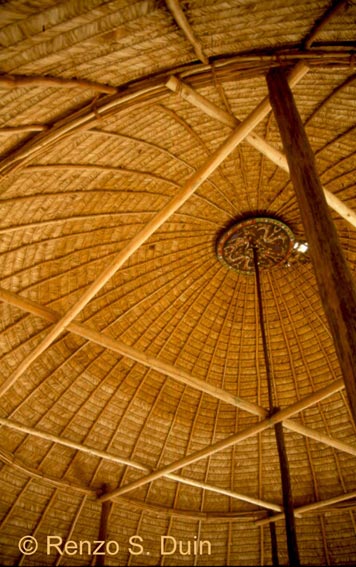
Photo interior Tukusipan, |
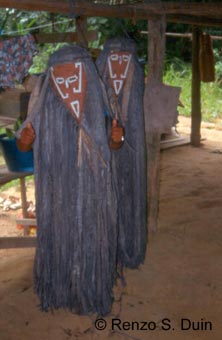
| 
Tamok | 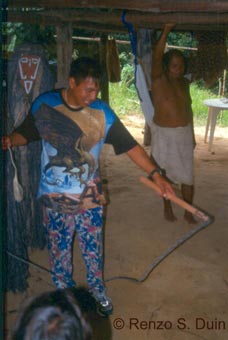
|
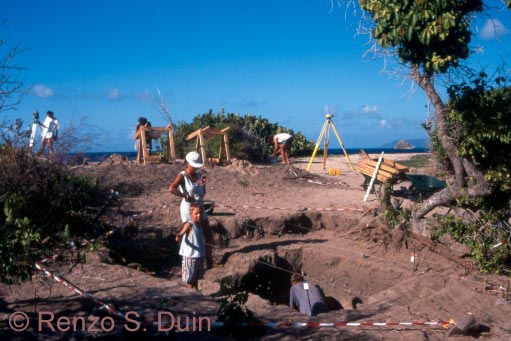
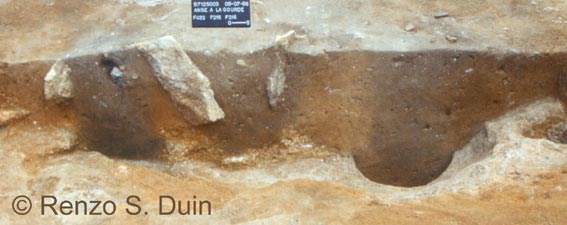
Archaeological excavation at Anse à la Gourde, Guadeloupe, FWI. May 1995 | In 1995 I attended the Field School at Anse à la Gourde, Guadeloupe, (French West Indies) under supervision of Corinne Hofman and Menno Hoogland of the Rijks Universiteit Leiden and André Delpuech of the DRAC Guadeloupe.
Part of this site, excavated during the Summers of the following years, became the topic of my 1998 M.A. Thesis on Architectural concepts in Caribbean Archaeology.
|

Example of one of the reconstructed houses at Anse à la Gourde and a contemporary Wayana house. |
My research has focused on built environment, architecture, settlement planning and landscape. For my dissertation research I analyze the architecture, settlement planning and landscape of the Wayana, in relation to settlement organization. We have to go beyond the static structure and engage into the dynamic and constantly emerging organization. This study is in continuation of the questions derived from my M.A. research. |
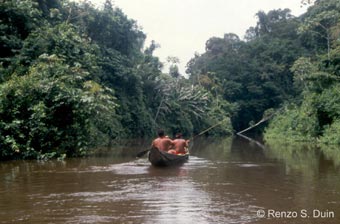 Further into the past, 2003. | As an academic researcher, I have worked since 1996 among Indigenous peoples named Wayana -- also referred to as Roucouyennes in historical documents. In the 17th and 18th centuries, up to present, several Cariban speaking groups were reunited under the name Wayana. Today a little over one thousand Wayana live in Suriname, French Guiana and Brazil. The Wayana society continues to cherish much of their traditional social organization, political structures, and cultural expressions, including their own language. While, at the same time, they are incorporating the treats of the 21st century, as there are outboard motors, CD and DVD players, and satellite dishes. In the summer of 2005 I had a consulting task for the RijksMuseum voor Volkenkunde (RMV) Leiden, the Netherlands, consisting of a review and providing data for the exhibition: " de Goeje in Suriname". In the summer's of 2006 and 2007 I had a consulting task for the Florida Museum of Natural History (FLMNH), Gainesville, FL. consisting of identifying and cataloguing objects from the Amazonian Collection. |
| 
|
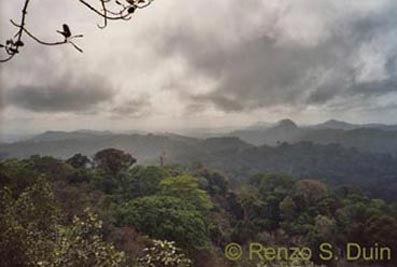
Towards Toukouchipann from Mitaraka sud |
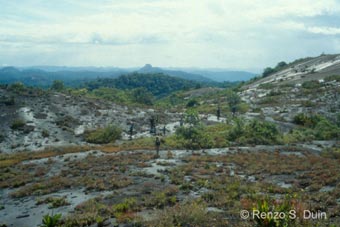
Taluwakem |
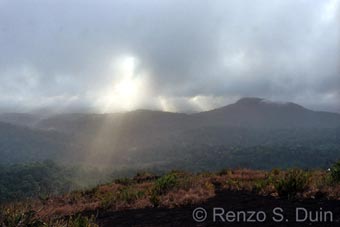
From T1 towards the north east |
|
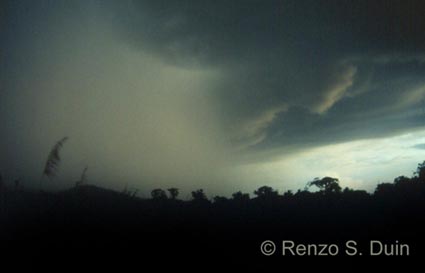
And then came the rains |
Acknowledgements: Living and conducting research in the Tropical Lowlands of northern South America would not be possible without the hospitality, friendship, and life lessons of so many Wayana individuals and communities.
I would like to thank the many friends in Suriname and French Guiana for their continued advice and support.
All illustrations and photo's are made by Renzo Duin, unless I'm on the pics myself or mentioned otherwise.Contact information: Contact me by e-mail if you have questions about or comments on my research projects.
Copyright © Renzo S DUIN| Last modified: July 23, 2010 | Hosted by: UF